When searching for DNA testing services in the USA, many people feel confused by one key question: Should I choose a legal DNA test or a non-legal DNA test?
While both options use the same scientific technology, they serve very different purposes.
In this guide, you’ll clearly understand:
- The difference between legal and non-legal DNA tests
- Which one courts and USCIS accept
- Cost differences
- When to choose each option
What Is a Legal DNA Test?
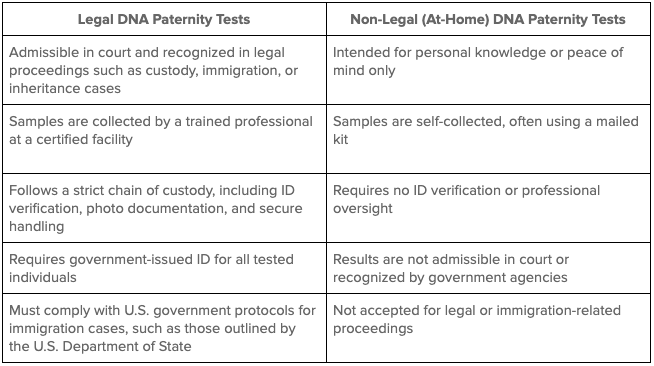
A legal DNA test is designed for official use and can be accepted by:
- Courts
- Government agencies
- USCIS and U.S. embassies
- Child support offices
To be legally valid, the test must follow strict chain-of-custody procedures.
Key Features of a Legal DNA Test
- Identity verification with government-issued ID
- Sample collection by a certified professional
- Witnessed cheek swab collection
- Secure handling and documentation
- Results signed by an accredited laboratory
Common Uses
- Court-ordered paternity cases
- Child custody and child support
- Adding or removing a parent from a birth certificate
- Immigration and visa applications
- Legal inheritance claims
What Is a Non-Legal DNA Test?
A non-legal DNA test, often called a peace-of-mind test, is used for personal information only.
These tests are usually:
- Purchased online
- Collected at home
- Faster and more affordable
Key Features of a Non-Legal DNA Test
- No ID verification required
- No witness needed
- Self-collected cheek swabs
- Results delivered online or by email
Common Uses
- Personal curiosity
- Family reassurance
- Relationship clarification
- Private confirmation
⚠️ Non-legal DNA tests cannot be used in court or for immigration.
Legal vs Non-Legal DNA Test: Side-by-Side Comparison
| Feature | Legal DNA Test | Non-Legal DNA Test |
|---|---|---|
| Court accepted | Yes | No |
| USCIS accepted | Yes (AABB only) | No |
| Identity verification | Required | Not required |
| Chain of custody | Required | Not required |
| Sample collection | Professional | Self-collected |
| Typical cost | $250–$500 | $120–$200 |
| Result time | 3–7 business days | 2–5 business days |
Do Legal and Non-Legal DNA Tests Use the Same Science?
Yes.
Both tests analyze the same DNA markers and can reach 99.99% accuracy.
The difference is not accuracy, but documentation and oversight.
Which DNA Test Should You Choose?
Choose a Legal DNA Test If You Need:
- Court-admissible results
- Immigration DNA testing
- Government recognition
- Official documentation
Choose a Non-Legal DNA Test If You Want:
- Fast and affordable results
- Personal information only
- No appointments or paperwork
If there’s even a small chance you’ll need the results legally in the future, it’s smarter to start with a legal DNA test.
Can a Non-Legal DNA Test Be Upgraded Later?
No.
Once a test is collected without chain-of-custody, it cannot be converted into a legal test.
You would need to re-test with a certified DNA testing center.
Legal DNA Tests for Immigration Cases
For immigration cases, legal testing must meet AABB accreditation standards.
Important notes:
- Only AABB-accredited labs are accepted
- Results are sent directly to USCIS or the embassy
- At-home kits are automatically rejected
How Long Do Results Take?
- Non-legal DNA test: 2–5 business days
- Legal DNA test: 3–7 business days
- Immigration DNA test: 2–12 weeks
Express processing is available at many DNA testing centers.
Where Can You Get a Legal DNA Test?
Legal DNA tests must be collected at:
- Certified DNA testing centers
- Authorized specimen collection sites
- Mobile collection services (in some cities)
Directory websites like dnacentersusa.com help users find approved DNA testing centers near them.
Yes, but they are not legally valid.
No, courts require chain-of-custody testing.
Yes, and it must be AABB-accredited.
Understanding the difference between legal and non-legal DNA tests helps you avoid wasted time, money, and repeat testing.
If results are needed for any official purpose, always choose a legal DNA test from a certified DNA testing center.